John was a great teacher, mentor, and friend, so it was very sad to learn of his sudden death. A detailed obituary about John can be found here.
This is just some of the many memories that come tumbling out as I think about John and our long association.
I first learned about John from Dwain Warner, who had overseen John’s PhD research in the Sierra de Los Tuxtlas in southern Veracruz, Mexico. Not long after reading some of John’s papers about that work, I was able to go with Dwain and John Gerwin to Los Tuxtlas to do bird censuses (1982-83). That was an amazing trip; Dwain showed us a lot of Mexico. He went back up to Minnesota with Mario Ramos so Mario could finish his dissertation, leaving John Gerwin and I to carry on with bird censusing. In walking the back roads doing censuses, we met the herpetologist Dick Vogt, who worked at the nearby UNAM field station. One day he stopped and told us that he’d heard that John Rappole was in the Sierra de Santa Marta at a remote field site, and that if we wanted to we could all go in together and meet him. We did.
The site was indeed remote. The road from the small town of Catemaco in to the village of La Peninsula de Moreno was not really driveable with my Volkswagen Rabbit; the muffler got scraped off on some rocks, and we had to stop and walk in when we were blocked by a creek. Some kind people at La Peninsula pointed up the Rio Coxcoapan toward the study site, and we followed boot tracks in the mud on both sides of the river (we got a lot of wading in) to a site in pristine tropical rainforest. There, John Rappole and two students were running a grid of mist nets doing a study of wintering Wood Thrushes. We had a great conversation, and John R. invited John G. and I to stop by at his home in Kingsville, Texas on our way north in a month or two when our bird censusing was done. We did.
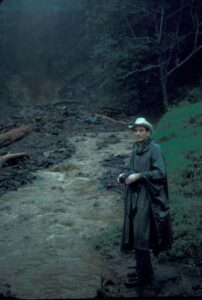
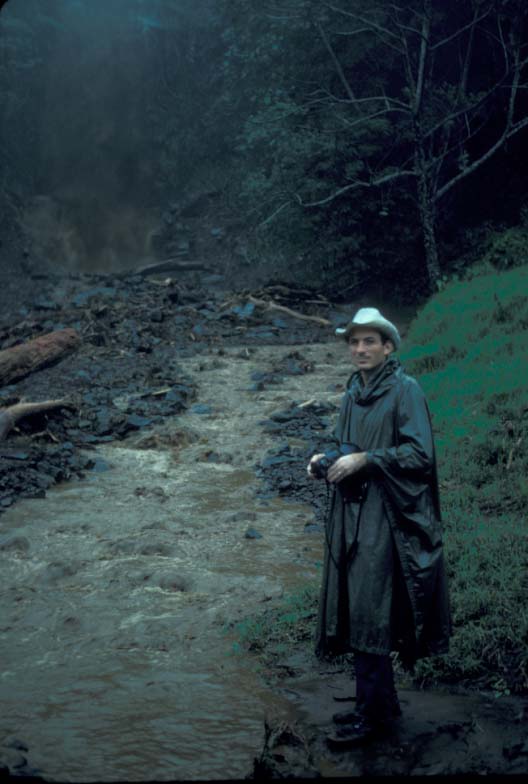
John Rappole during a norte in Los Tuxtlas
Back in Minnesota, I had the opportunity to get to know Mario Ramos as he worked on completing his dissertation. The Wood Thrush study was his and John’s, and between the two of them they talked me into coming down the next winter to work on it with them. That began a long and wonderful collaboration. That winter, I drove to Kingsville, then John and I drove the project’s World Wildlife Fund Chevy Blazer down to Los Tuxtlas, stopping in Xalapa to pick up Jacinto Hernandez, an INIREB employee under Mario’s supervision who was going to be working with us at the study site.
That first winter was a steep learning curve for me. I had not spent much time in rainforest before, and I did not know much Spanish. John set us up, showed us how to put radio transmitters on the birds and track them, and then went back to Kingsville. Jacinto and I carried on, and I knew I was hooked on studying migratory birds. John and Mario invited me to join them in Xalapa mid-winter for the second meeting of the Neotropical Ornithological Society (under its former name). Not only was it great to get to catch up with them about the study and other bird-related topics, I was able to meet many other ornithologists studying tropical birds.
On my way north later to get back to school, I stopped in Kingsville again and stayed with John, Bonnie, and the family for a day or two. We talked about my taking on the Wood Thrush project for a Masters thesis (I was still an undergrad), and that’s what we did. I would spend three more seasons on that project, with many other people, each time accompanied down to Los Tuxtlas by John to get us set up. John was a tireless engine of enthusiasm and field skills.
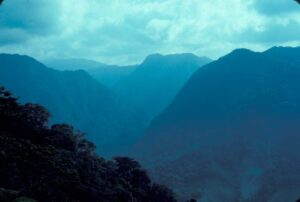
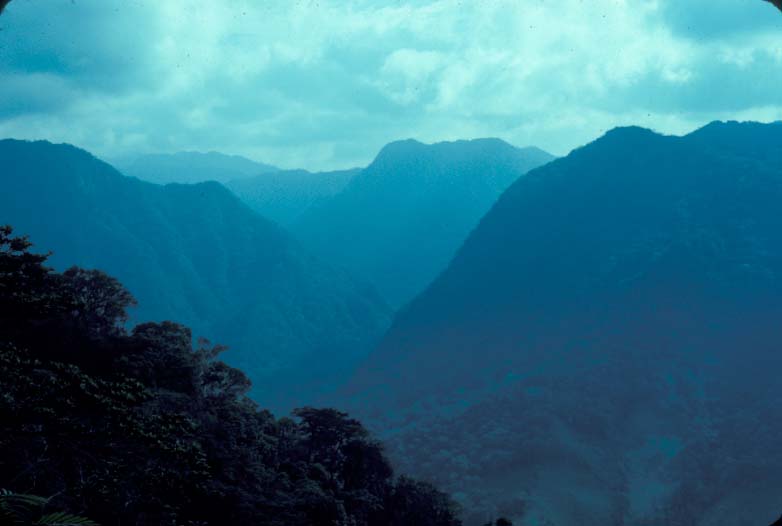
Valley of the Rio de Coxcoapan
Over that first season, John got us set up with a local pilot, Moices Estrada, to fly his small single-engine plane once a week or so to search for transmitter signals from floaters, nonterritorial Wood Thrushes. One day at La Peninsula John told me that when he had proposed the project he had wanted to buy an ultralight aircraft and fly that to find the signals of the transmitters that could no longer be found from the ground, even from the nearby peaks. His university turned him down, though, saying it was too risky. As I looked around the extremely rugged landscape, thickly forested, I remember thinking well, they were probably right. There was no place at all for emergency landings. I still use this as an example when telling people that, yes, while institutions can have an excessive amount of CYA policies that probably don’t really reduce risk (but do require increasing amounts of training and time), they can occasionally get things right.
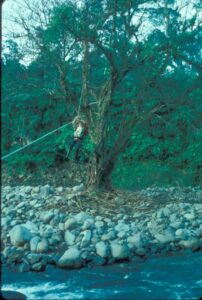
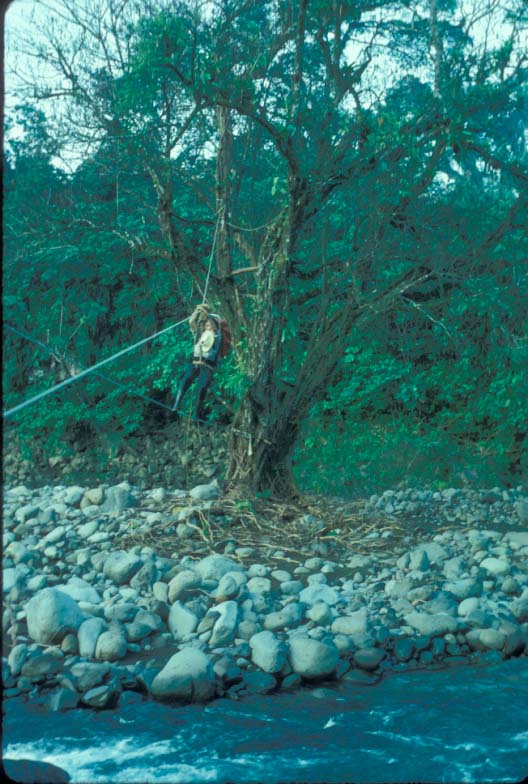
John Rappole testing the rope bridge used to cross the Coxcoapan to the study site during high water.
We published a series of papers together on the Wood Thrush project, and at the same time I was working on another project in Minnesota for my PhD. In the meantime, John had moved to the Smithsonian Institution’s Conservation & Research Center in Front Royal, Virginia. As I was completing my dissertation, John suggested that I apply to come and work there as a postdoc. It was a great idea, the project was funded, and Rose and I moved to Front Royal after defending our respective PhD dissertations. Soon enough I was back in Los Tuxtlas doing migratory stopover site work there.
One of the best things for me about Front Royal was that this was the first time John and I had been co-located for long periods, so we had a lot of time to talk about migration. John had an encyclopedic grasp of the migration literature. Those long, highly detailed, fruitful discussions were invaluable to me in integrating the ecology of migration (John’s greatest strength) with my other interests in avian diversity and the evolutionary processes causing it. I know John also appreciated our discussions.
This was at about the time email became commonplace, so after Rose and I moved to Alaska, John and I had long, ongoing correspondence, exchanging manuscript drafts for comments and keeping up with major developments in migration research. Fully 15 years after Rose and I moved here and after John and Bonnie had retired and moved to New York, John was an invaluable and eager participant in what I like to think of as a “Let’s get the band back together!” effort on a Los Tuxtlas data retrospective. We had talked about it, including with Dwain and Mario, as a possible long-term goal when we had been able to achieve decadal mist-net sampling in the 70s, 80s, 90s, and the 00s by stringing together a series of collaborative projects (the latter two with Patricia Escalante). Sadly, Dwain and Mario had passed away before we completed the writeup, but it sure was fun to work with John again. (https://peerj.com/articles/179/)
John was always moving forward. Unstoppable. Among our last emails, I learned that he was working on yet another book and that he had used preprints to get out some manuscripts that reviewers were not enthused about.
John will be greatly missed.